
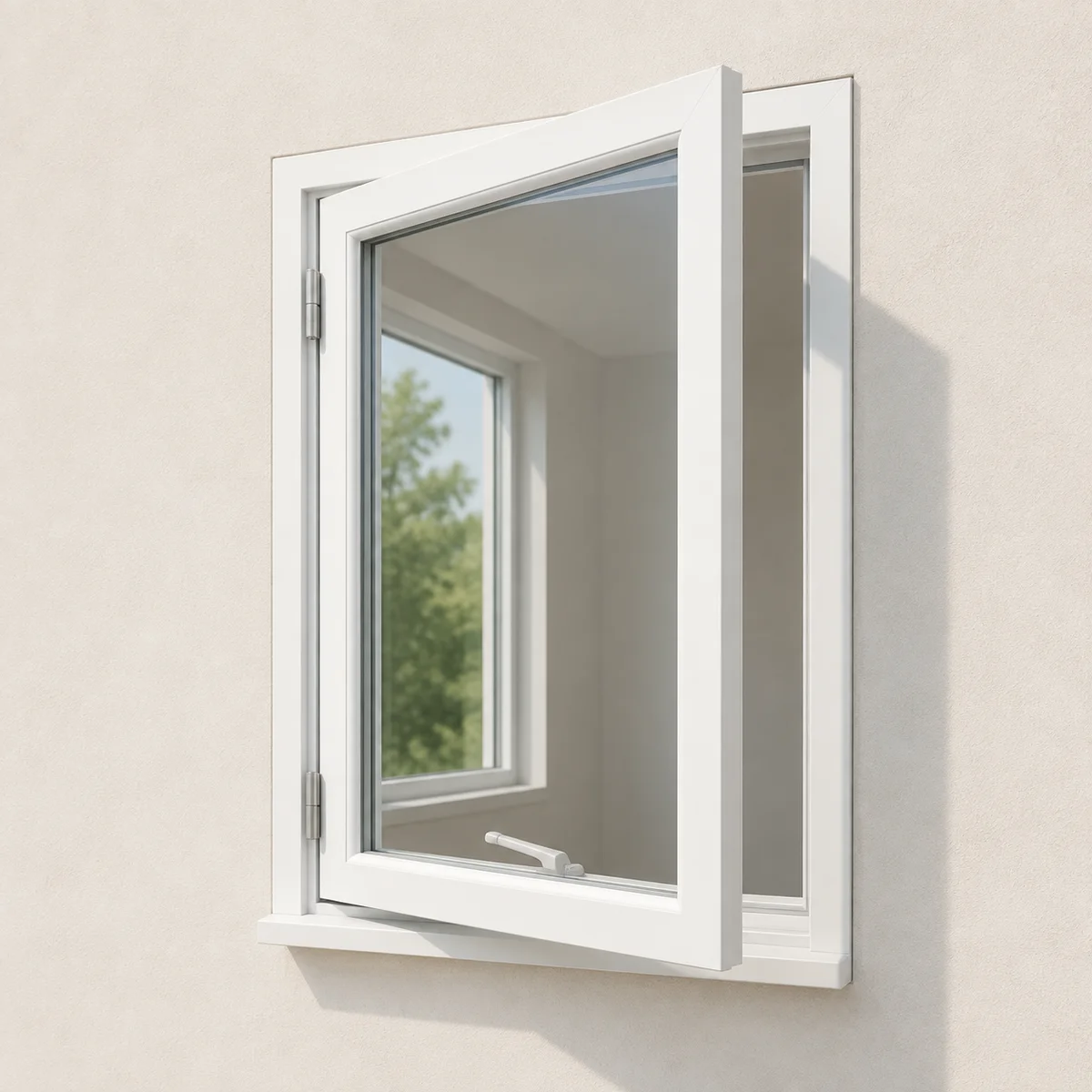
Is this the right window for your room?
A practical place to start when you want an opening window with a broad view. A crank can be easier to reach over a kitchen counter than a sliding sash, but check the handle position against your sink and backsplash.
The sash swings outside. Leave clearance from paths, planting, decks and neighbouring openings. Large or heavier glass packages change the load on the hinges and operator, so size limits must be checked for the actual configuration.
How the design works
Multi-point locking draws the sash into the seals. Look at the closing action as well as the handle: the sash should settle evenly without needing to be pushed by hand. A profile sample helps show where the weather seals sit.
| Detail | What to know |
|---|---|
| Operation | Side hinged, outward swing |
| Configuration | Crank operator |
| Planning detail | Compression seals |
| Typical application | Kitchen, living area and bedroom openings |
Construction of casement windows
A casement is supported along one vertical edge, so the hinge side carries the sash while the operator moves it. Glass weight, sash width and the position of the locking points must be considered together. This is why a larger triple-glazed casement can need a different hardware arrangement from a small double-glazed unit.
On the vinyl configurations in our product reference, internal frame chambers, welded corners and reinforcement form the structure around the glass. Reinforcement supports the moving sash; the weather gaskets provide the contact seal. These perform different jobs, and adding locking points cannot correct an opening installed out of square.
A corner-drive arrangement can extend the locking action toward the upper corner of a wider sash. During a showroom demonstration, watch the entire sash return to the frame. It should close in a controlled movement before the lock is engaged, without using the lock to pull a visibly misaligned sash into position.
Hardware, support and everyday operation
The following components explain what to compare in this configuration. The order specification identifies the exact supplied parts; an option listed here is not automatically included in every unit.
| Component | Its role in your window |
|---|---|
| Hinges | Carry the sash and establish its swing path. Hinge capacity must match the glass weight and approved dimensions. |
| Crank operator | Reference choices include Truth/Encore and compatible heavy-duty operators. Confirm the exact operator and handing on the order. |
| Perimeter locking | Multiple engagement points draw the sash into the gaskets. A corner drive is a configuration choice, not an automatic feature on every size. |
| Handle and lock style | Compare folding operator handles and classic, flat or slim lock treatments for reach and clearance. EVO2/Ferco components require system compatibility. |
| Interior screen | A removable or spring-loaded screen sits inside because the sash opens outside. Try releasing and reinstalling it before selecting a blind. |
Colours, glass, grilles and finishing choices
| Selection | What to decide for this style |
|---|---|
| Finish | Coordinate the exterior frame with brickmould and choose the room-side finish around existing casing. Check the approved sample rather than a colour on a phone. |
| Glass | Compare double and triple glazing at the same size. A heavier laminated or triple-pane package changes the hardware discussion. |
| Privacy | Textured or decorative glass can suit a side-facing opening; compare visibility after dark with indoor lights on. |
| Grilles | Check grille alignment where an operating casement sits beside a fixed unit. The visible sash proportions may differ. |
| Interior trim | Allow the jamb extension to meet the finished wall and leave the crank clear of the sill and backsplash. |
| Blinds | An inside-mounted blind needs clearance from the folded handle and room for the screen to be removed. |
Installing casement windows
For a kitchen replacement, photograph the sink, tap, backsplash and interior sill as well as the outside opening. A window can fit the wall yet be awkward to operate if the handle lands behind a deep counter or directly above a tall fixture.
At handover, open the sash, bring it back with the crank, engage each locking action and remove the screen. Ask the installer to demonstrate the permitted cleaning position. Do not assume that every hinge allows the same access to the exterior glass.
Configuration energy-performance references
These figures are reference ranges for researched glazing configurations, not a rating for every size or option. Select a model-specific record before ordering. U-factor units were not identified in the reference table, so confirm the report units before comparing these figures with another quote. No annual Most Efficient designation is inferred from this table.
| Glazing reference | Energy Rating (ER) | U-factor · units to confirm | SHGC |
|---|---|---|---|
| Double pane | 34 - 36 | 1.28 - 1.49 | 0.42 - 0.47 |
| Triple pane | 31 - 33 | 0.95 - 0.98 | 0.23 - 0.24 |
Casement size reference
The researched configuration has the following size limits. These are a planning reference, not approval for an individual opening; confirm the ordered series, hardware and glass thickness. Width, height and area limits apply together.
| Glass | Min. width | Min. height | Max. width | Max. height | Max. area |
|---|---|---|---|---|---|
| Double pane | 16 in | 15 in | 36 in | 70 in | 17 sq ft |
| Triple pane | 16 in | 15 in | 30 in | 65 in | 14.5 sq ft |
Watch and compare in person
Explore the showroom overview to see the scale of the displays, then try the relevant opening style during your visit. Individual product-operation footage will be added after the dedicated filming; a showroom overview is not a demonstration of this exact configuration.
A look at the production setting
A short view of window assemblies and equipment on the manufacturing floor. This is background context for the product conversation, not a complete account of every production stage.
Read the silent video description
The camera moves through a manufacturing area with window assemblies, equipment and workstations. This silent overview shows the setting rather than a step-by-step production tutorial.