
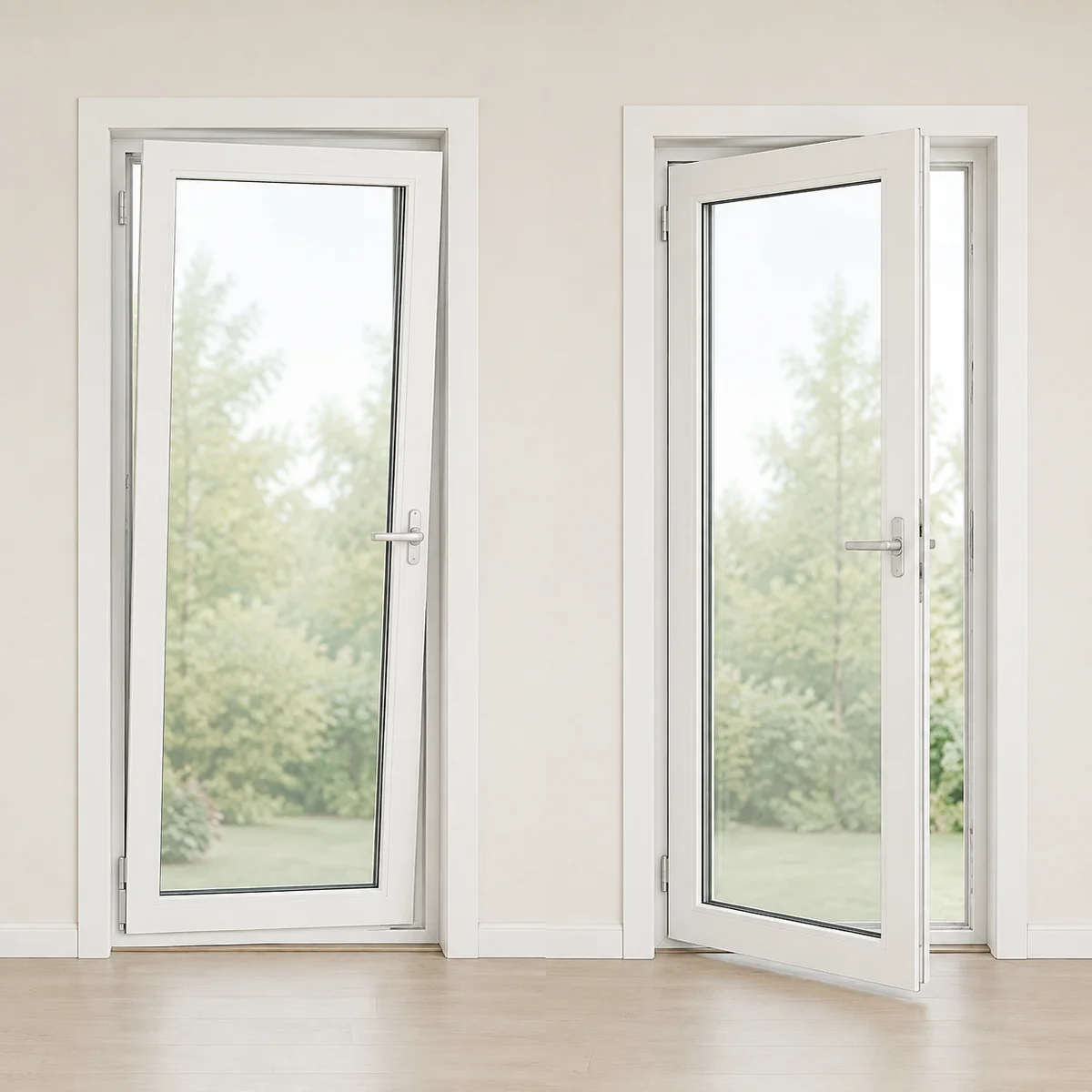
Choose around the way you live
Try the sequence on a display and ask which panel moves in each mode. Understand the difference between an inward-turning leaf and a tilt-and-slide mechanism before comparing quotes; the names alone are not enough.
Consider curtains, blinds, nearby furniture and the threshold. Hardware must be matched to panel dimensions and glass weight. Ask for the system drawing and operating instructions before finalizing the order.
Configurations and the complete opening
| Design choice | What the drawing should establish |
|---|---|
| Two-panel composition | Identify which leaf tilts or turns and which portion is fixed; a two-panel description does not define the movement. |
| Three- or four-panel composition | Review every operating leaf, intermediate frame and opening direction on a plan. |
| Ventilation mode | The restricted opening should have a clear operating sequence and compatible hardware. |
| Full access mode | Confirm the inward swing or other exact movement; a tilt-and-slide product is a separate mechanism. |
Construction, glazing and hardware
The ventilation and full-opening modes place different demands on the hardware. The handle position, locking gear and hinges must coordinate, particularly with larger glazed leaves. Try the actual mechanism before comparing it with a conventional patio slider.
Reinforcement and hardware capacity must suit the selected glass weight. The phrase multi-point locking describes an arrangement of engagement points, not a universal security rating for every available panel size.
An inward-turning leaf uses room-side space. Furniture, curtains, blinds and the approach to the door need to be drawn into the layout. The main daily-use position should be convenient without rearranging the room.
Details to compare
| Consideration | Planning point |
|---|---|
| Construction | Two operating modes |
| Configuration | System-specific panel movement |
| Compatibility | Hardware and glass compatibility |
| Installation | Interior clearance review |
Glass, privacy and finishing
Door glazing changes both the appearance and the view into your home. Compare clear, textured and decorative options under light, and consider the position of sidelites and transoms at different times of day.
Choose finishes and hardware together. Ask which interior and exterior colours, handles, locks and screen options are supported by the selected system. Product drawings and physical samples help resolve details that a small catalogue image cannot show.
Installation details for this system
Agree on the precise system name and the movement shown by its drawing. For a large patio opening, review the hinge support, level threshold and alignment throughout the complete assembly.
The handover should demonstrate a safe, repeatable handle sequence and how the leaf is closed before another mode is selected. Keep the operating instructions near the door until household members are familiar with it.
See a patio system in motion
A showroom demonstration of an operating patio-door panel. Compare the movement and available space, then confirm the exact system and configuration selected for your opening.
Read the silent video description
A person operates a glazed patio-door panel in the showroom. The view shows how the moving panel changes the opening and how the hardware is used. The demonstrated assembly is a reference and does not establish the specification of every patio system.